


Tacoma Truck Accident Lawyer
Tacoma truck accident lawyer helping crash victims across Pierce County. Free evaluation. Pay nothing unless we win.

A Tacoma truck accident lawyer helps injured people recover compensation after crashes involving semi-trucks, delivery trucks, freight vehicles, and other commercial trucks.
Truck accident claims are different from regular car accident claims. A serious truck crash in Tacoma may involve the driver, the trucking company, a cargo loader, a repair company, a broker, a shipper, or a commercial insurance company. These cases move fast because driver logs, black box data, dispatch records, inspection reports, and video footage can be lost if they are not preserved quickly.
If you were hurt in a truck crash on I-5, SR 16, SR 167, SR 512, Pacific Avenue, South Tacoma Way, near the Port of Tacoma, or anywhere in Pierce County, Strong Law can help you understand your rights and build your claim around the facts.
Free case review: Talk with a truck accident attorney in Tacoma today. You pay no fee unless we win.
Quick Answers About Tacoma Truck Accident Claims
What does a Tacoma truck accident lawyer do?
A Tacoma truck accident lawyer helps figure out what caused the crash, who may be responsible, what evidence needs to be saved, and what compensation may be available.
When should I call a truck accident attorney after a Tacoma crash?
You should call a truck accident attorney if you were injured, the crash involved a commercial vehicle, the trucking company denies fault, or the insurance company is pushing you to give a statement or accept a quick settlement.
Why are truck accident claims different from car accident claims?
Truck accident claims often involve commercial insurance, trucking company records, driver logs, maintenance records, federal safety rules, and more than one responsible party. The injuries are also often more serious because of the size and weight of commercial trucks.
Who can be liable after a truck accident in Tacoma?
The truck driver may be liable, but other parties may also share responsibility. That can include the trucking company, delivery company, cargo loader, repair company, vehicle manufacturer, broker, shipper, or another driver.
What evidence matters most after a truck accident?
Important evidence may include the police report, black box data, driver logs, inspection reports, maintenance records, dashcam footage, dispatch records, cargo documents, witness statements, photos, and medical records.
How long do I have to file a truck accident lawsuit in Washington?
Most Washington injury lawsuits must be filed within three years under RCW 4.16.080. Some cases have shorter deadlines, especially if a government vehicle, public agency, or public road issue is involved.
What if the trucking company says I was at fault?
Do not assume the trucking company is right. Washington follows comparative fault under RCW 4.22.005, which means fault can be split between parties. A strong investigation can challenge unfair blame.
Why Truck Accident Claims Are Different From Car Accident Claims
A truck crash is not just a bigger car accident. Commercial trucking cases involve different evidence, stronger insurance pressure, and often more serious injuries.
After a crash, the trucking company and its insurer may act quickly. They may send investigators, collect their own evidence, repair the truck, download electronic data, or start building a defense before you know what evidence matters.
A truck accident case may involve questions like:
- Was the driver tired or over the legal driving limit?
- Was the truck overloaded or loaded the wrong way?
- Were the brakes, tires, lights, or safety systems maintained?
- Did the company pressure the driver to meet an unsafe delivery schedule?
- Did the driver break federal or company safety rules?
- Did the trucking company hire or train the driver properly?
- Did a repair company miss a serious mechanical issue?
- Did a broker, shipper, or cargo loader help cause the crash?
The sooner evidence is saved, the stronger the case usually becomes.
If your crash involved a regular passenger vehicle instead of a commercial truck, our Tacoma car accident lawyer page may be more specific. If you are not sure where your case fits, a Tacoma accident lawyer can help identify the right type of claim.

Contents
Tacoma Freight Routes and Truck Crash Risk
Tacoma has a strong local trucking angle because freight traffic is part of daily life in the city. Commercial trucks move through Tacoma on highways, industrial roads, delivery routes, and Port-connected corridors.
Truck crashes in Tacoma and Pierce County may happen on or near:
- I-5 through Tacoma
- SR 16
- SR 167
- SR 512
- Pacific Avenue
- South Tacoma Way
- South 38th Street
- Tacoma Dome area
- Port of Tacoma roads
- Industrial areas near freight and warehouse traffic
- Delivery routes near businesses, neighborhoods, and construction zones
These local details matter. A crash near the Port of Tacoma may involve freight movement, container traffic, delivery schedules, or several companies. A delivery truck crash near a Tacoma business may involve employer liability, route pressure, or company vehicle rules. A highway crash on I-5 may involve speed, lane changes, fatigue, braking distance, and multiple vehicles.
Evidence That Can Disappear After a Commercial Truck Crash
Evidence is one of the most important parts of a Tacoma truck accident claim. Some evidence can be lost, overwritten, repaired, or destroyed if action is not taken quickly.
Important truck accident evidence may include:
- Black box or electronic control module data
- Driver logs
- Hours-of-service records
- Dispatch records
- GPS and route data
- Dashcam or cab camera footage
- Maintenance records
- Inspection reports
- Brake, tire, and repair records
- Cargo loading records
- Weight tickets
- Driver training and safety files
- Drug and alcohol testing records
- Cell phone records
- Company safety policies
- Witness statements
- Photos and videos from the crash scene
- Nearby business camera footage
A preservation letter can help stop key evidence from being deleted or changed. Strong Law can move quickly to identify what should be saved and who has it.
Learn more about the records, electronic data, video, and physical evidence that can disappear after a Tacoma truck accident.
Who Can Be Liable After a Tacoma Truck Accident?
Truck accident claims often involve more than one responsible party. The truck driver may have caused the crash, but the driver is not always the only person or company responsible.
A claim may involve:
The truck driver.
The driver may be responsible if they were speeding, distracted, impaired, tired, following too closely, changing lanes unsafely, or breaking traffic laws.
The trucking company.
The company may be responsible for unsafe hiring, poor training, unsafe delivery pressure, missed repairs, or ignored safety problems.
A delivery company or employer.
If the truck was being used for work, the employer may be responsible for what the driver did during the job.
A cargo loader.
Cargo that is too heavy or not secured can shift, spill, or make the truck harder to control.
A repair or maintenance company.
A repair company may be responsible if bad work, missed inspections, or unsafe repairs helped cause the crash.
A manufacturer or parts company.
Defective brakes, tires, lights, steering parts, or other truck parts may create additional liability.
Another driver.
Sometimes another driver helps cause a truck crash by cutting off the truck, stopping suddenly, or causing a chain reaction.
The key is not only identifying who hit you. The key is identifying every person or company whose choices helped cause the crash.
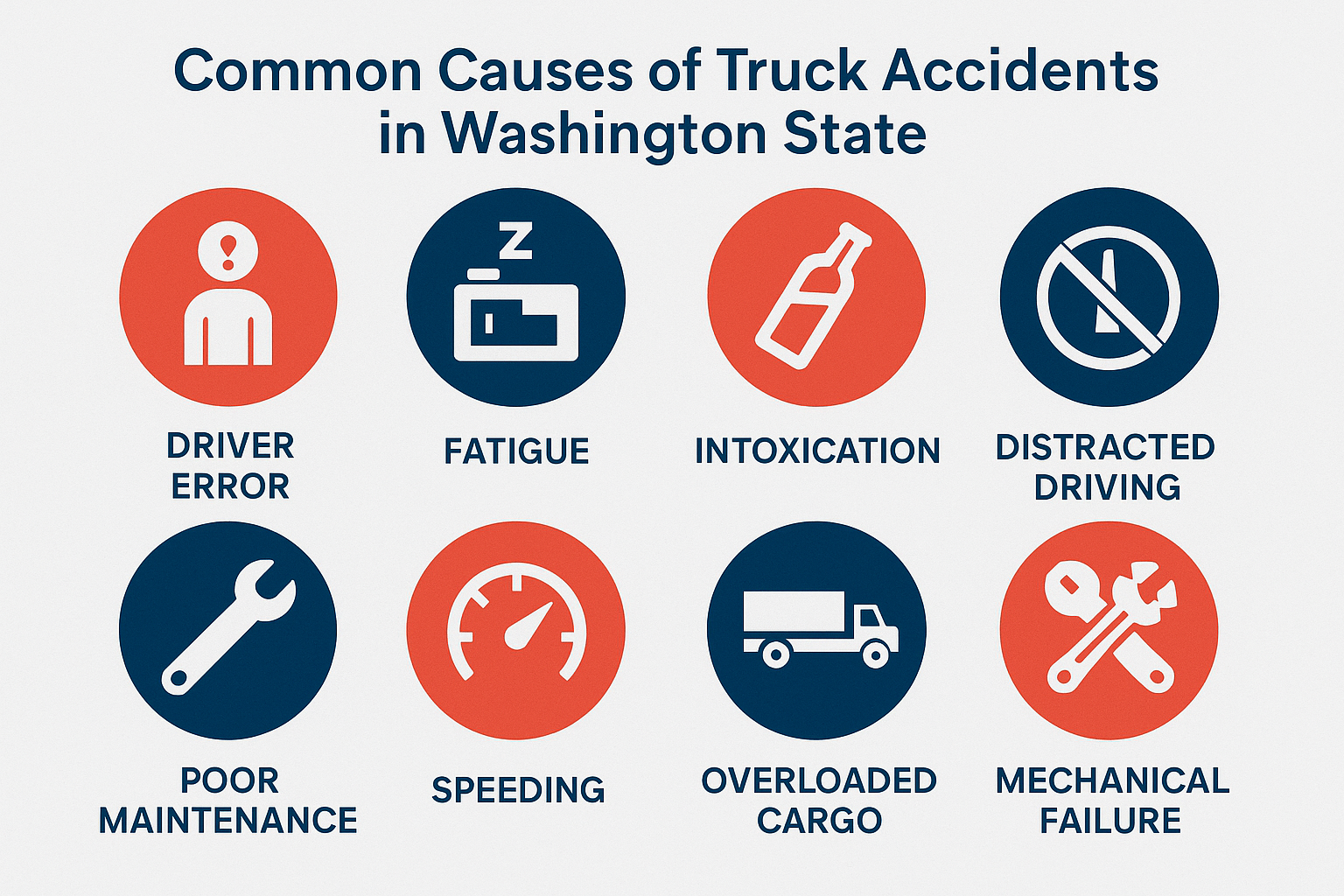
Common Causes of Truck Accidents in Tacoma
Truck accidents can happen because of driver error, company pressure, poor repairs, unsafe cargo, or a mix of problems.
Common causes include driver fatigue, distracted driving, speeding, unsafe lane changes, tailgating, impaired driving, overloaded trailers, unsecured cargo, brake failure, tire failure, poor truck maintenance, blind-spot crashes, wide-turn crashes, and unsafe backing.
Tacoma truck crashes may also involve traffic congestion, tight delivery routes, steep roads, wet pavement, construction zones, and heavy freight traffic near industrial areas. These factors can make a truck harder to stop, turn, or control.
Get Your Free
Case Review

Injuries After a Tacoma Truck Accident
Truck accidents often cause severe injuries because commercial trucks are much heavier than passenger vehicles. Even a lower-speed crash can cause serious harm when a large truck hits a smaller vehicle, pedestrian, cyclist, or motorcycle rider.
A truck injury attorney can help connect the crash to the medical evidence, especially when the injuries involve surgery, long-term treatment, missed work, or permanent limits.
Common injuries include:
- Concussions and traumatic brain injuries
- Neck and back injuries
- Herniated discs
- Spinal cord injuries
- Broken bones
- Crush injuries
- Internal injuries
- Severe cuts and scarring
- Burns
- Shoulder, hip, and knee injuries
- Amputations
- Chronic pain
- Permanent disability
- Emotional trauma
If the crash caused headaches, dizziness, memory problems, confusion, or other brain-related symptoms, our Tacoma brain injury lawyer page explains how these claims are documented.
If the truck crash caused paralysis, amputation, severe burns, spinal injury, or permanent disability, our Tacoma catastrophic injury lawyer page may be more specific.
Compensation in a Tacoma Truck Accident Claim
A truck accident claim should account for the full impact of the crash, not just the first medical bill.
Compensation may include:
- Emergency medical care
- Ambulance bills
- Surgery
- Hospital stays
- Physical therapy
- Medication
- Future medical care
- Lost wages
- Reduced earning capacity
- Pain and suffering
- Emotional distress
- Disability
- Scarring or disfigurement
- Home changes
- Mobility equipment
- Property damage
- Loss of enjoyment of life
- Wrongful death damages when the crash is fatal
Truck accident claims may involve higher insurance limits than regular car accident claims. That does not mean the insurance company will pay fairly. Commercial insurers often fight hard because the money at stake can be high.
What If the Trucking Company Denies Fault?
It is common for a trucking company or insurer to deny fault after a serious crash. They may blame you, another driver, the weather, road conditions, or an “unavoidable” emergency.
That does not make the denial true.
Fault can depend on evidence you may not have at first. Driver logs, maintenance records, GPS data, camera footage, inspection reports, and company safety records can change the direction of a case.
A truck crash attorney can help challenge the company’s version of events by requesting records the injured person may not be able to get alone, including driver logs, black box data, maintenance files, inspection records, dispatch notes, and camera footage.
A Tacoma truck accident attorney can help push back when the trucking company tries to control the story before all evidence is reviewed.
Video: Why Statements After a Truck Accident Can Harm Your Claim
After a truck accident, the trucking company or insurance carrier may ask for a statement before you know the full facts, your injuries, or what evidence exists. What you say early can be used to dispute fault, downplay your injuries, or reduce the value of your claim.
This video explains why statements after a truck accident can harm your claim and what to do instead.
Watch: Why statements after a truck accident can harm your claim — and what to do instead.
We’ve helped thousands of accident victims like you
we win
98%
4.9
stars
over
2,000


“Very professional, and treated me as an equal.”
"Just wanted to say thank you to Jed and his team at Strong Law. Not only was I happy with the outcome, but the entire process as a whole. I would definitely recommend this firm to anyone. Thanks again."
“Unbelievable work!”
"I had a claim involving my own insurance company. I tried to negotiate with them, and they completely denied my claim – two times. I then hired Strong Law, and the change was instant. The insurance company immediately began negotiating, and Jed was able to secure an unbelievably good settlement. I will never again attempt to take-on an insurance company without Strong Law in my corner. Thank you!"

“I got justice and awesome compensation.”
"I hired Strong Law after my car accident. Jed and his team worked hard on my case. They were professional and compassionate through my surgery and as I recovered, and they were awesome on communication. I got justice and awesome compensation. I would recommend Strong Law to anyone in my situation."
Washington Law and Federal Trucking Rules
Truck accident claims in Tacoma may involve Washington injury law and federal trucking safety rules.
Most Washington injury lawsuits must be filed within three years under RCW 4.16.080. Missing this deadline can stop you from filing a lawsuit, even if your injuries are serious.
Washington’s comparative fault law can also affect compensation. Under RCW 4.22.005, your compensation may be reduced if you are found partly responsible for the crash. Insurance companies may use this rule to shift blame, so evidence matters.
Federal trucking rules may also apply. The Federal Motor Carrier Safety Administration sets safety rules for many commercial trucks and carriers. These rules can involve driving hours, inspections, maintenance, cargo securement, driver training, and vehicle safety. A violation may help show that a driver or company acted carelessly.
What to Do After a Truck Accident in Tacoma
The steps you take after a truck accident can affect your health and your claim.
After a Tacoma truck accident:
- Call 911 and request medical help if anyone is injured.
- Get medical care as soon as possible.
- Report the crash and request the collision report when available.
- Take photos of the vehicles, truck markings, trailer, license plates, injuries, road conditions, and crash scene.
- Get witness names and contact information.
- Avoid giving a recorded statement before you know your rights.
- Do not accept a quick settlement while you are still treating.
- Save medical bills, work records, repair estimates, and insurance letters.
- Preserve dashcam footage or photos if you have them.
- Contact a lawyer quickly if a commercial truck, company vehicle, or serious injury is involved.
The Washington State Patrol provides information about collision records and how reports can be requested.
Semi-Truck, Commercial Truck, and Delivery Vehicle Claims
Truck crashes can involve many types of commercial vehicles. A semi truck accident lawyer may handle different evidence than a lawyer reviewing a smaller delivery truck claim, but both cases can still involve company records, insurance disputes, and serious injuries.
Strong Law helps with claims involving semi-trucks, tractor-trailers, box trucks, delivery trucks, dump trucks, flatbeds, work trucks, construction vehicles, and other commercial vehicles.
If you need a Tacoma semi truck accident attorney after a crash, the most important step is preserving evidence before the trucking company controls the story. If you were seriously hurt, a Tacoma truck accident injury attorney can help review the driver, the company, and the records behind the crash.
A Tacoma commercial truck accident lawyer can also look beyond the driver to see whether unsafe company practices, poor repairs, bad loading, or delivery pressure played a role.
Fatal Truck Accidents in Tacoma
Truck crashes can cause fatal injuries. When that happens, the case may involve wrongful death law, estate issues, funeral costs, lost financial support, and the emotional impact on surviving family members.
Fatal truck accident claims often require a deeper investigation. The case may involve commercial insurance, company records, driver history, repair failures, cargo issues, and corporate safety decisions.
If your family lost someone in a truck crash, our Tacoma wrongful death lawyer page explains how these claims work.
Why Choose Strong Law for a Tacoma Truck Accident Claim
Strong Law is a Tacoma personal injury firm helping people throughout Pierce County and Washington after serious crashes and injuries. If you need a Tacoma injury lawyer after a commercial truck crash, our team can help preserve evidence, deal with insurance companies, and build a claim around the full impact of your injuries.
Truck accident cases require fast action, careful evidence review, and a clear plan for dealing with commercial insurers. Strong Law focuses on building claims with proof, not guesswork.
A major advantage is insurance-side insight. Before founding Strong Law, attorney Jed Strong worked as in-house counsel for GEICO, defending insurance companies in injury claims. That background helps the team understand how insurers review cases, dispute injuries, and decide when to settle.
Strong Law also works on a contingency fee basis. That means there is no upfront attorney fee, and you pay no attorney fee unless compensation is recovered for you.
Our Tacoma office is located at:
Strong Law Accident & Injury Attorneys
1120 Pacific Ave Suite 110
Tacoma, WA 98402
Talk With a Tacoma Truck Accident Lawyer Today
If you need Tacoma legal help after a truck accident, do not wait for the trucking company or insurance carrier to control the evidence.
Strong Law can review what happened, explain your options, identify available insurance coverage, and help you pursue compensation for your injuries and losses.
Call now: (206) 737-1421 for a free consultation with a Tacoma truck accident lawyer. You pay no fee unless we win.
Get Your Free
Case Review
Frequently Asked Questions About Tacoma Truck Accident Claims
What makes a truck accident claim different from a car accident claim?
Truck accident claims often involve commercial insurance, trucking company records, driver logs, maintenance records, federal safety rules, and more than one responsible party. These cases are usually more complex than regular car accident claims.
Who can be held responsible for a Tacoma truck accident?
The truck driver may be responsible, but the trucking company, delivery company, cargo loader, repair company, vehicle manufacturer, broker, shipper, or another driver may also share fault.
What evidence should be preserved after a truck accident?
Important evidence may include black box data, driver logs, GPS records, dispatch records, maintenance files, inspection reports, dashcam footage, cargo records, witness statements, medical records, and photos from the scene.
How long do I have to file a truck accident lawsuit in Washington?
Most Washington truck accident injury lawsuits must be filed within three years. Some claims may involve shorter deadlines, especially if a government vehicle, public agency, or public road issue is involved.
Can I recover compensation if I was partly at fault?
Yes. Washington uses comparative fault. Your compensation may be reduced by your percentage of fault, but being partly responsible does not automatically prevent you from recovering compensation.
What if the trucking company says its driver did nothing wrong?
A denial does not end the case. Trucking companies and insurers may deny fault before all evidence is reviewed. Driver logs, black box data, maintenance records, inspection reports, and camera footage may tell a different story.
How much is my Tacoma truck accident case worth?
The value depends on your injuries, medical treatment, lost income, future care needs, pain and suffering, available insurance, and the strength of the evidence. Serious injuries and disputed fault usually require deeper case review.
How do I choose the best truck accident attorney in Tacoma?
Look for a lawyer who understands commercial trucking evidence, insurance company tactics, serious injury claims, and Washington injury law. The right attorney should act quickly to preserve records and explain your options clearly.
Is a trucking accident lawyer different from a regular accident lawyer?
A trucking accident lawyer focuses on the extra issues that come with commercial truck crashes, such as company records, federal rules, driver logs, black box data, maintenance records, cargo loading, and commercial insurance.
How much does it cost to hire Strong Law?
There is no upfront cost. Strong Law works on a contingency fee basis, which means you pay no attorney fee unless compensation is recovered for you.
How Strong Law will handle your case

We review reports, photos, video, witness information, medical records, and other evidence to identify what happened and who may be responsible.

We gather medical, wage, property, and daily-life evidence to show how the injury or loss affected the client.
We identify available insurance, manage insurer communication, and respond to delays, low offers, and attempts to shift blame.

If the other side denies responsibility or refuses a fair resolution, we can file a lawsuit and prepare the case for court.
Contact us
Our team is standing by to help you.