

Warning Signs Don’t Eliminate Liability

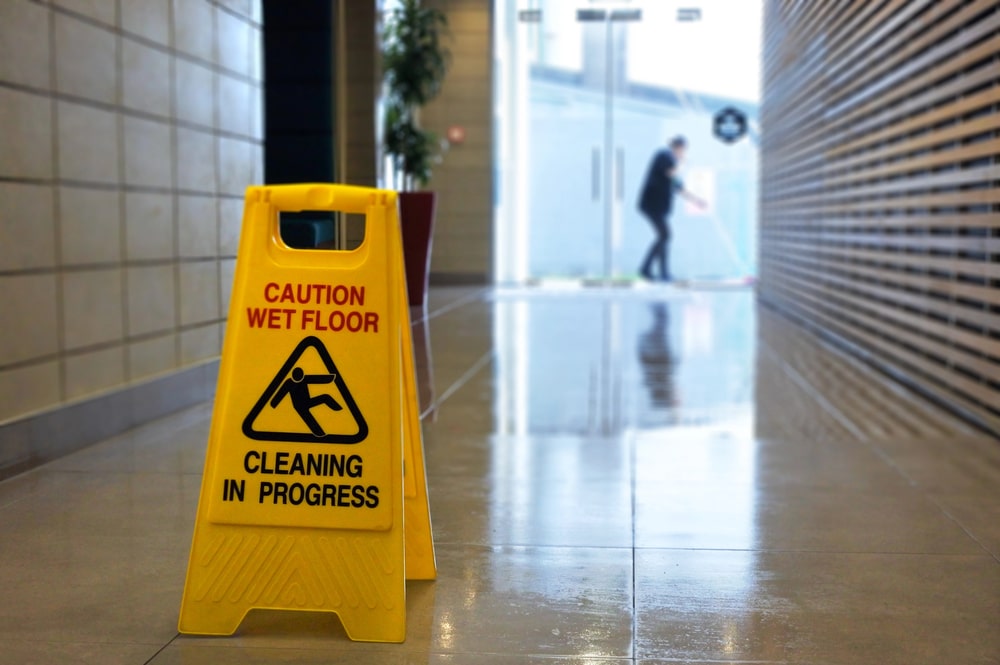
You slipped on a wet floor even though there was a warning sign. Now you’re convinced that the yellow placard just destroyed your case, the good news is that it didn’t. Property owners love to point at wet floor signs as proof they did everything right. Washington courts don’t buy that argument automatically. A warning sign is one factor among many, and it doesn’t give businesses a free pass when someone gets hurt on their property. The law requires property owners to keep their spaces reasonably safe for visitors. Sometimes that means more than just plopping down a bright yellow cone and calling it a day.
When Wet Floor Signs Actually Matter
Context is everything. A properly placed sign in a well-lit area during slow business hours? That’s different from a single small cone hidden in a crowded, dimly lit corridor where hundreds of people are rushing through. Courts look at whether the warning was adequate for the actual conditions. If staff mopped the floor and immediately marked it, you’re dealing with one scenario. But what if water pooled there for ninety minutes before anyone bothered to acknowledge the hazard? That’s negligence with a side of cheap caution tape. The sign’s location matters too. One entrance gets marked while three others remain completely unwarned. Customers don’t deserve to play premises liability roulette every time they walk through a different door.
What Washington Law Actually Requires
Business owners can’t just react to dangers. They have to prevent them. Here’s what the law expects:
- Regular inspections to spot hazards before someone gets injured
- Prompt action to fix dangerous conditions
- Adequate warnings for risks that can’t be immediately corrected
- Reasonable steps to prevent foreseeable harm to visitors
A Tacoma slip and fall lawyer can tell you whether the property owner actually met these standards in your situation. Warning signs represent the bare minimum, not some gold standard of safety.
The Adequacy Question Changes Everything
What matters is whether the warning is sufficient. Picture this: someone mops during off-peak hours in a spacious, brightly lit area with clear sightlines. A standard wet floor sign probably works there. Now imagine the lunch rush at a busy restaurant. People are carrying trays, kids are running around, and sight lines are blocked by other customers. That same sign suddenly becomes worthless. The floor condition itself factors in heavily. If the surface was so dangerously slippery that even careful, attentive people would fall despite seeing the warning, the property owner can’t hide behind that sign. You don’t get to create an ice rink and then claim a warning absolves you of responsibility.
Your Actions Still Factor Into the Case
Washington uses comparative negligence. Were you staring at your phone and walking right past an obvious sign that was directly in your path? A jury might assign you some fault, which reduces your compensation proportionally. But it won’t necessarily kill your entire claim. Property owners consistently overestimate how much protection a warning sign provides. The sign’s mere existence doesn’t prove you should have seen it or that it adequately communicated the actual danger you faced.
Documentation Becomes Critical
Take photos immediately after you fall. Show exactly where any signs were positioned, how the lighting looked, what blocked your view, and how wet the area was compared to how dry it was. These details become ammunition when you’re challenging whether the property owner actually provided reasonable protection. Get witness information if you can. Did other people almost fall in the same spot? Did anyone comment on how inadequate the warnings were? This evidence demonstrates that the sign didn’t do its job. Your Tacoma slip and fall lawyer needs to review every detail of what happened. The specific facts of your incident determine its strength far more than whether a caution sign was somewhere in the general vicinity.
Moving Forward With Your Claim
A wet floor sign complicates things, but it doesn’t end them. Many successful slip and fall claims involve situations where warnings existed but didn’t provide reasonable protection. What courts care about is whether the property owner took appropriate steps given all the circumstances. The totality matters more than checking a single box labeled “placed warning sign.”
For other common questions, read our slip and fall FAQ covering evidence, responsibility, and potential damages.
Strong Law Accident & Injury Attorneys can evaluate whether you have a viable claim despite any warnings that were present. Don’t assume a yellow cone means you’re out of options. The law is more nuanced than that, and your injuries deserve a thorough analysis of what the property owner should have done differently.

See If Your Injury Claim May Qualify
Answer a few quick questions to help Strong Law understand what happened and whether your claim may qualify for a free review.
