

How to Get Denver Traffic Camera Video After a Crash

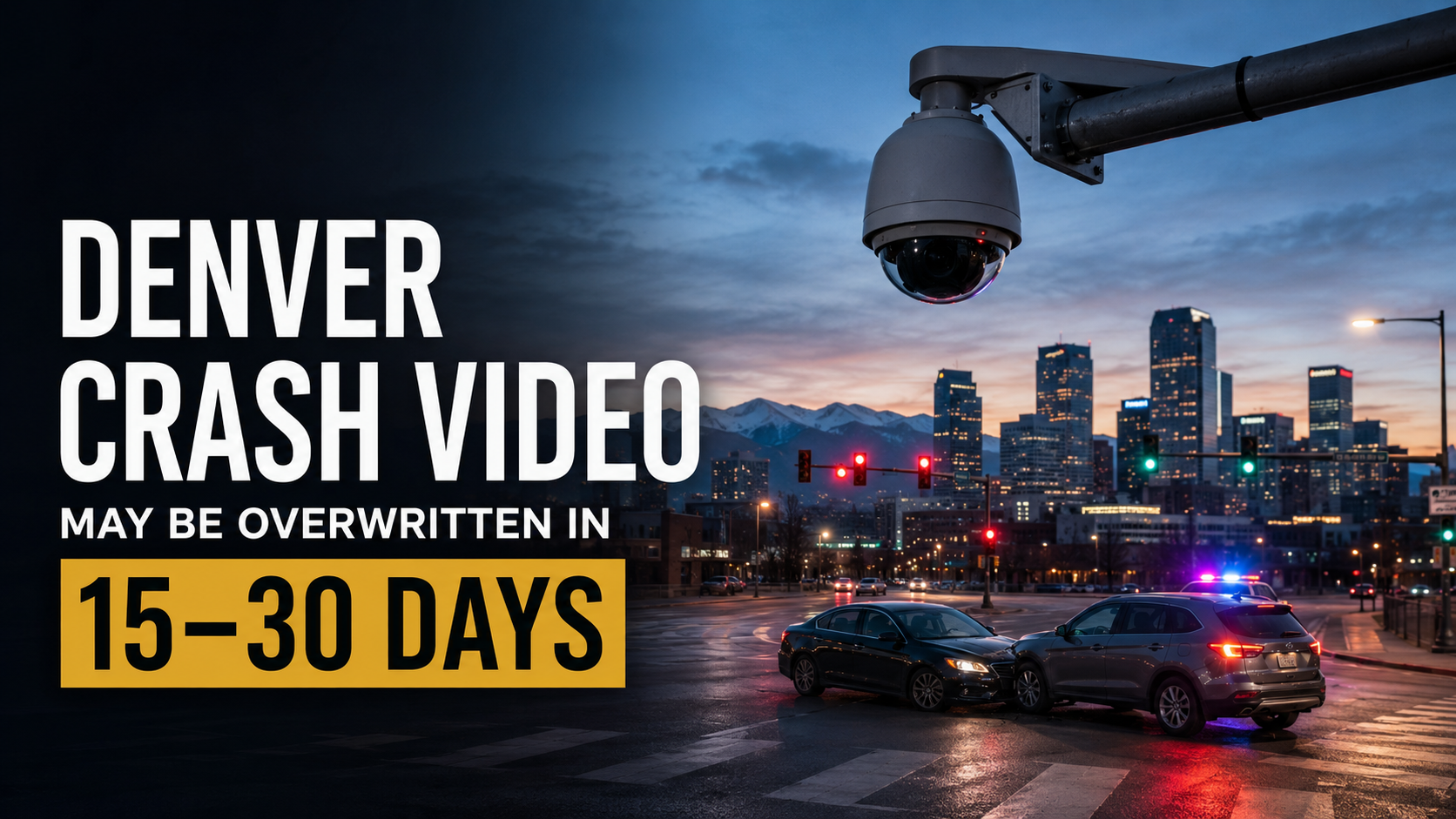
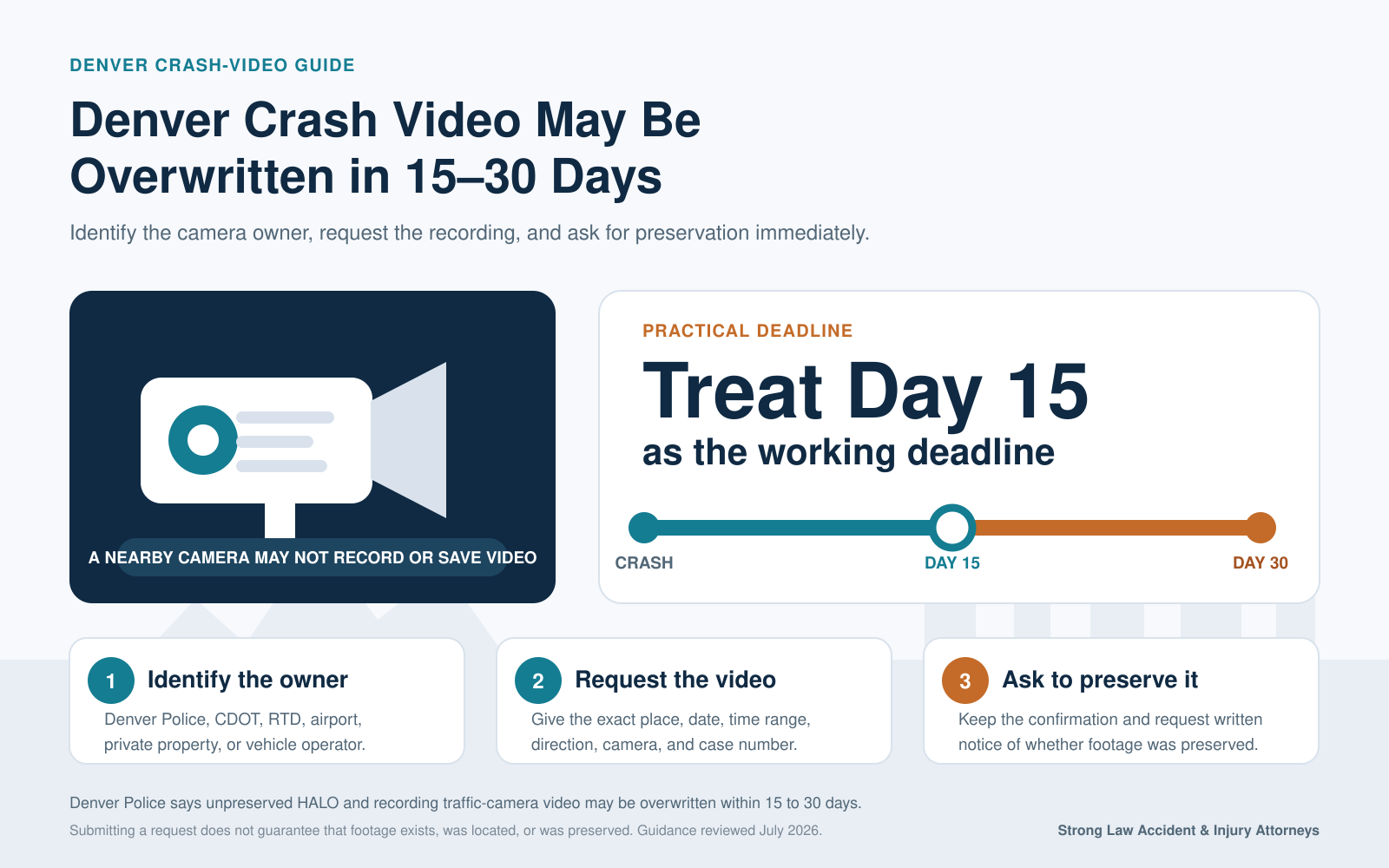
Denver Police allows people to request HALO and recording traffic-camera video through its online records system. However, the department says unpreserved footage may be overwritten within 15 to 30 days. Check the official HALO camera map, identify the exact location and time, and submit a request that expressly asks the department to preserve the recording while the request is processed.
Do not wait for the insurance company, a completed crash report, or a decision about hiring a lawyer. Denver’s portal currently warns that some video requests take six to eight weeks. That delay does not stop unpreserved video from being overwritten. This short window can be especially important when fault is disputed in a Denver car accident claim.
A visible camera does not guarantee useful video exists. It may show only a live view, face another direction, or belong to CDOT, RTD, a private owner, or another agency.
What Should You Do First?
If a Denver traffic camera may have recorded a crash, take these steps as soon as possible:
- Write down the exact date, location, and best estimate of the crash time.
- Preserve your phone’s original photos, videos, and location data.
- Check Denver’s official HALO camera map for nearby city cameras.
- Identify other likely sources, including CDOT, RTD, businesses, homes, parking facilities, and dashcams.
- Submit a narrow request that asks for preservation and a copy.
- Save the confirmation, request number, and every response.
A five- or ten-minute window is easier to search than several hours. Use 911 call history, messages, receipts, vehicle data, or the crash report to narrow an uncertain time. Asking for preservation does not guarantee that a recording was found or saved. Keep the confirmation and ask for written notice of whether the video was preserved.
What Are Denver HALO Cameras?
HALO stands for High Activity Location Observation. Denver Police uses this network to monitor public streets and other high-activity locations.
Denver publishes an interactive HALO camera map. Search for the crash address or intersection, zoom in, and note any camera near the scene. Record the camera’s mapped location and take a screenshot for your files.
The map does not prove that a recording exists. A nearby camera may have faced away, moved between views, been blocked, or been unavailable. Describe the collision clearly enough for staff to search.
How Long Does Denver Keep Traffic-Camera Footage?
The Denver Police records page states that unpreserved video from HALO or recording traffic cameras is overwritten between 15 and 30 days.
The safe approach is to treat 15 days as the working deadline. Submit the request immediately, even if the crash report is not ready. In the description, ask Denver Police to preserve the identified footage while the request, payment, review, and delivery are pending.
This is a practical preservation target, not a statutory filing deadline or a guarantee that footage will remain available for 15 days.
How Do You Find the Right Camera Owner?
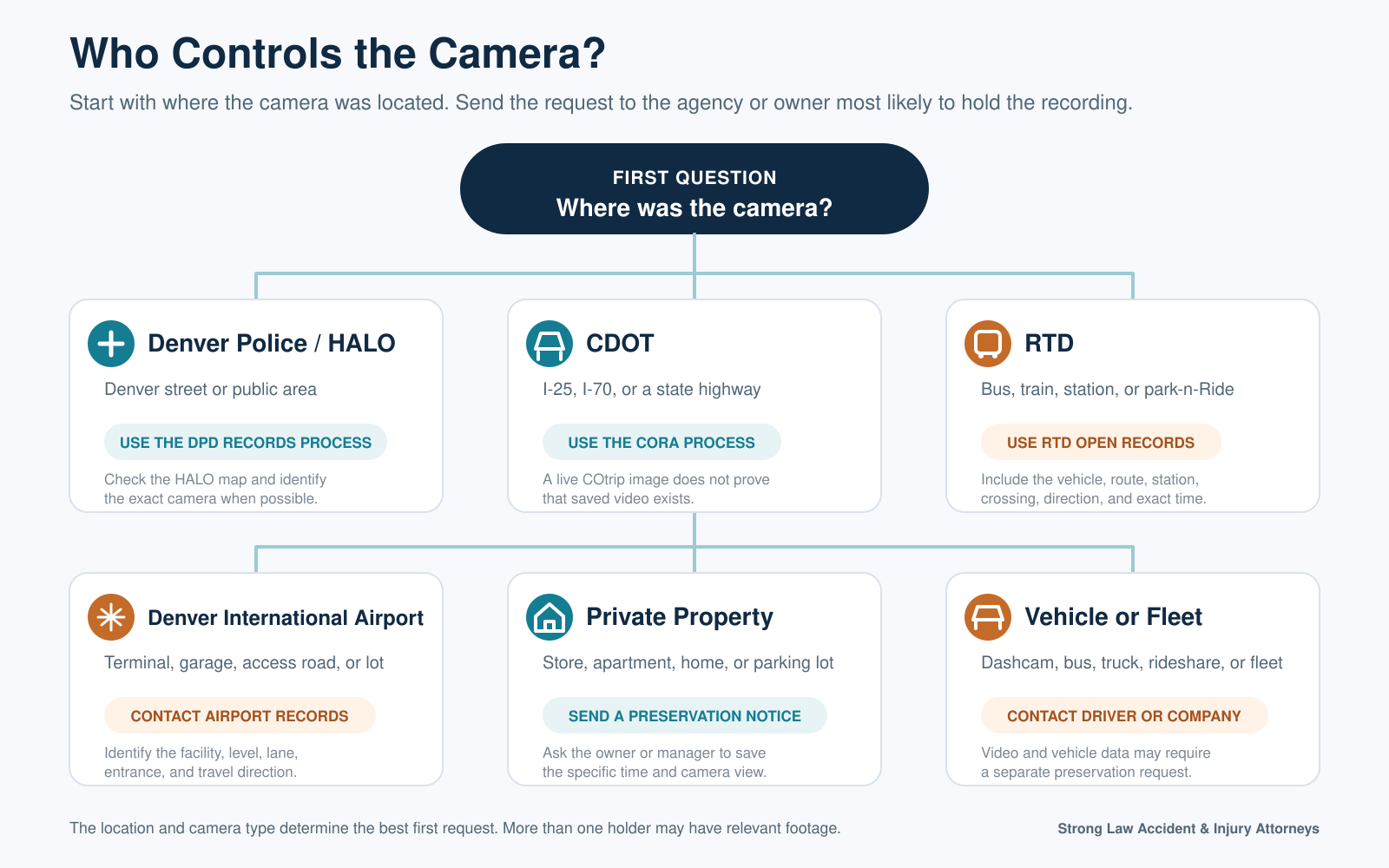
The camera’s location and purpose often determine who controls it.
| Possible video source | Likely holder | Where it may be useful |
|---|---|---|
| HALO or Denver recording traffic camera | Denver Police Department | Denver streets, intersections, and public areas |
| CDOT roadway camera | Colorado Department of Transportation | I-25, I-70, U.S. highways, and state-controlled roads |
| RTD camera | Regional Transportation District | Buses, trains, stations, crossings, and park-n-Rides |
| Denver International Airport camera | Denver International Airport | Terminal roads, parking, pickup areas, and airport property |
| Business or residential camera | Property owner or system user | Storefronts, parking lots, entrances, doorbells, and driveways |
| Vehicle camera | Driver, fleet owner, rideshare company, or trucking company | Dashcam, onboard safety video, and outward-facing fleet footage |
The location alone does not identify the camera owner. A collision inside Denver may involve a state highway, RTD property, or a privately operated camera. More than one request may be needed.
How Do You Request HALO or Denver Traffic-Camera Video?
Denver Police directs HALO and recording traffic-camera requests through its online records portal. The portal is also used for police audio, video, photographs, and body-camera footage.
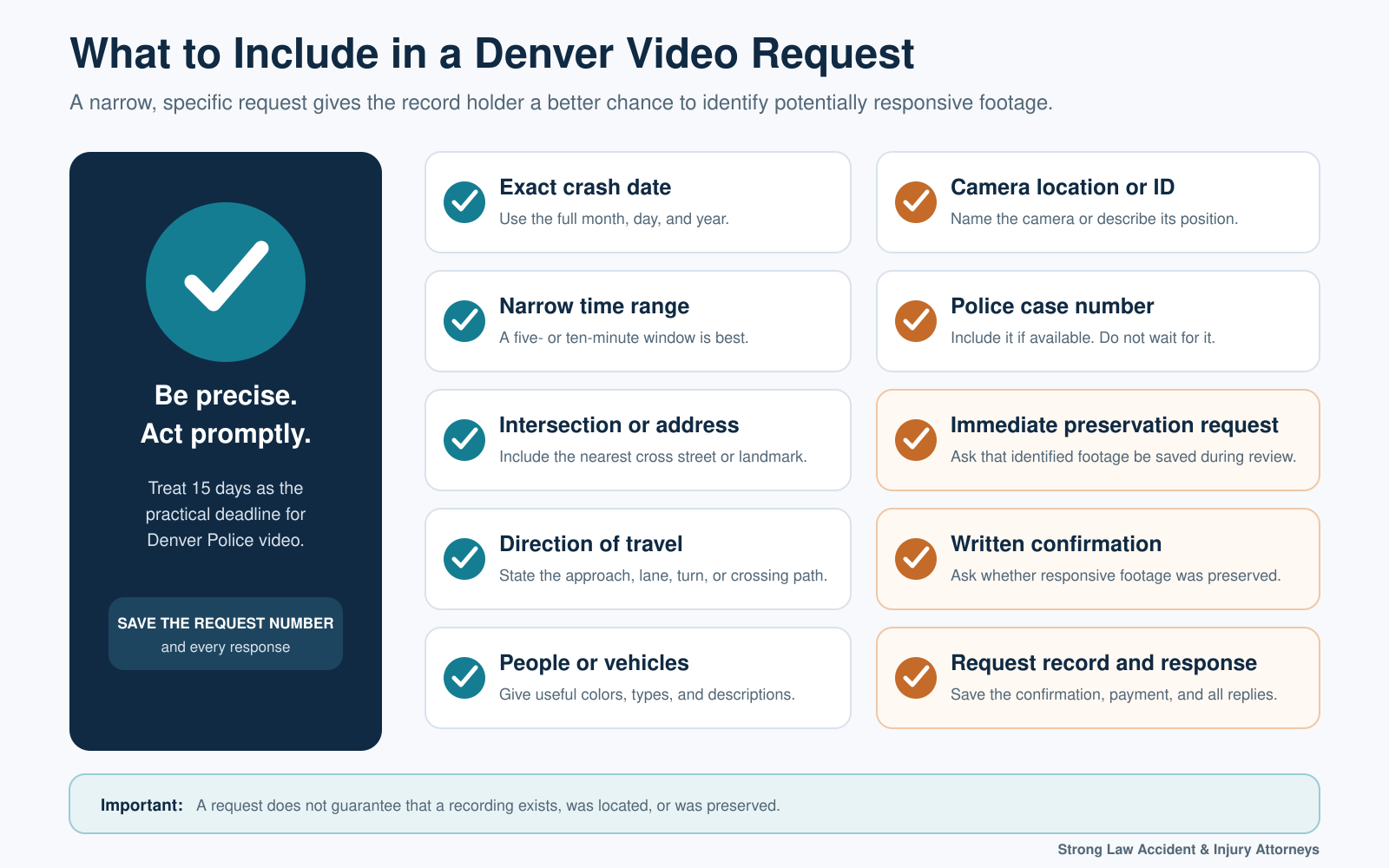
Before starting, gather:
- The crash date and the narrowest possible time range
- The intersection, street address, or highway location
- Travel directions, lanes, and vehicle details, if known
- The Denver Police case number, if available
- The mapped location of any nearby HALO camera
In the request, identify the record as HALO or traffic-camera video. State that the material relates to a traffic collision and ask for immediate preservation while the request is reviewed.
The system requires requesters to confirm that the records will not be used to solicit business for financial gain. Answer every statement truthfully and describe the purpose accurately.
What Should the Request Say?
A clear request can read:
Please immediately preserve and provide any available HALO or recording traffic-camera video showing the collision at [intersection or address] on [date] between [start time] and [end time]. The vehicles were traveling [directions of travel]. The collision involved [brief vehicle or pedestrian description]. Denver Police case number [number], if available. The HALO map shows a camera near [camera location]. Please preserve the original recording and its file details, including time stamps, while this request is reviewed.
Match the wording to the facts, and do not claim a camera recorded the crash unless you know it did. Answer requests for clarification promptly.
How Much Does Denver Charge, and How Long Does It Take?
Denver Police currently lists an initial $20 research fee for HALO and traffic-camera video, with added hourly charges when preservation or delivery requires more work. The final cost depends on the request.
The online portal currently says the Civil Liability Section is taking about six to eight weeks to provide records after it receives the information needed to process a request. Open investigations, criminal cases, privacy protections, redactions, technical issues, and the length of the recording can affect release.
Preservation and delivery are different steps. Submitting a request does not confirm that Denver found or saved a recording. Keep the confirmation and ask whether the video was preserved. Confirm current fees and timing on the official records page.
What Other Denver Police Records May Help?
Traffic-camera video is only one part of a crash investigation. Denver Police also accepts requests for:
- Body-worn camera video
- Police vehicle video, when available
- Scene photographs
- 911 audio and dispatch information
- Interviews and other audio recordings
- Investigation reports
These records may show witness statements, vehicle positions, road conditions, or visible injuries. Open cases and privacy rules can restrict release. Crash reports are ordered separately and usually become available five to seven days after they close. Self-filed online reports must be obtained through Colorado’s crash-reporting system.
Are CDOT Cameras the Same as Denver HALO Cameras?
No. CDOT operates traffic cameras along many interstates and state-controlled roads, including major sections of I-25 and I-70. Those cameras are separate from Denver Police’s HALO network.
Do not assume that a live image on COtrip means saved video exists. If a CDOT camera may be relevant, identify the route, direction, mile marker, interchange, exact time, and visible camera. Then use CDOT’s Colorado Open Records Act process to ask whether saved video or related records exist and to request preservation.
CDOT’s fee guidance says staff-time charges apply when a request requires more than one hour of research or retrieval. It does not guarantee that a record exists. Commercial-truck crashes may also produce video from fleet systems, onboard cameras, and nearby businesses. Strong Law’s Denver truck accident lawyer page explains why trucking-company evidence may require a separate preservation effort.
What if the Crash Was Near an RTD Bus, Train, or Station?
RTD has a Video Investigation Unit that supports its transit-police operations. A crash involving a bus, train, crossing, station, or park-n-Ride may have been recorded even when no HALO camera was nearby.
RTD accepts Colorado Open Records Act requests through its open-records portal. A request does not guarantee that RTD has releasable video from the location and time at issue.
Include the bus or vehicle number, route or train line, station or crossing, direction, and exact time. Ask for immediate preservation. If an RTD vehicle was involved, use the proper claims process too. A records request is not an injury claim.
How Do You Preserve Video From a Business or Home?
A store, hotel, apartment, parking garage, office, or home may have a better view than a public camera. A camera away from the impact point may show a vehicle’s approach, lane, direction, or flight from a hit-and-run.
Record every visible camera and property address. Contact the owner or manager quickly and ask that the relevant time window be preserved.
A private preservation notice should identify:
- The crash date, time range, and location
- The camera or area likely to contain the recording
- A request not to overwrite, alter, or delete the original file
- A request to preserve the original file, format, and time stamps
- Contact information for follow-up
The owner may provide a copy, save it without releasing it, require a subpoena, or decline. Keep the notice and proof of delivery.
For a pedestrian or bicycle collision, video may show a turning vehicle, crosswalk use, signal phase, lighting, or a driver leaving the scene. Strong Law provides more guidance on its Denver pedestrian accident lawyer page.
What if the Footage Is Missing, Withheld, or Unclear?
No recording does not mean there is no case. Use other evidence:
- Preserve original scene photos and videos, witness information, and the crash report
- Save damaged vehicles, bicycles, helmets, clothing, and electronic devices
- Download dashcam footage before the device loops over it
- Preserve phone, navigation, rideshare, and delivery records
- Obtain vehicle event-data and telematics information when appropriate
- Document medical care, missed work, and other losses
If an agency says no record exists, keep the response. The camera may not have been recording, the request may have used the wrong details, or the retention period may have passed. A denial or delay may also result from an open investigation, privacy issue, technical problem, or overly broad request.
Does Traffic-Camera Video Prove Who Was at Fault?
Not by itself. A recording may show a red light, unsafe turn, lane change, speed pattern, crosswalk, impact, or hit-and-run vehicle. It may also leave important questions unanswered because of distance, angle, darkness, missing audio, or blocked views.
Video should be compared with the signal sequence, roadway layout, witness accounts, vehicle damage, crash report, medical evidence, and data from the vehicles involved.
Colorado follows a modified comparative-negligence rule. Compensation may be reduced by the injured person’s percentage of fault, and recovery is generally barred when that person is found 50% or more at fault. Video may be important when the parties disagree about signals, lane position, speed, or right of way.
Do You Need a Lawyer to Request Denver Camera Footage?
No. A person can use the public request systems without a lawyer. For a property-damage-only crash with clear facts, handling the request and claim directly may be reasonable.
A legal consultation may make sense if:
- The crash caused a serious injury or death, or the insurer disputes fault
- A pedestrian, bicyclist, truck, or government vehicle was involved
- Several parties may hold video, or an owner refuses to preserve it
- The collision was a hit-and-run, the investigation remains open, or evidence may soon be overwritten
An attorney can identify camera holders, send preservation notices, follow records procedures, and use formal discovery if a lawsuit becomes necessary. That does not guarantee useful video exists.
Frequently Asked Questions
How long does Denver keep HALO camera footage?
Denver Police says unpreserved HALO and recording traffic-camera video may be overwritten between 15 and 30 days. Treat 15 days as the practical deadline and request preservation immediately.
Can anyone request Denver traffic-camera video?
Denver Police provides an online process, subject to legal restrictions. Requesters must answer required statements truthfully, provide enough detail to locate the recording, and pay applicable fees.
How much does Denver HALO video cost?
Denver Police currently lists a $20 initial research fee, plus possible hourly charges for preservation or delivery. The total depends on the request. Check the official Police Records page for current charges.
How long does a Denver video request take?
Denver’s portal currently estimates six to eight weeks for the Civil Liability Section to provide records after it has the needed information. Submit immediately because that timeline is much longer than the normal 15-to-30-day overwrite window.
Does every Denver traffic camera record and save video?
No. A visible camera or live traffic feed does not prove that historical footage exists. The camera may not record, may face another direction, may be temporarily unavailable, or may be controlled by an agency other than Denver Police.
What if there was no public camera near the crash?
Look for business, apartment, parking, doorbell, dashcam, fleet, rideshare, RTD, and witness video. Also preserve crash reports, 911 records, photos, vehicle data, damaged property, witness information, and medical records.
Does a traffic-camera recording guarantee a successful injury claim?
No. Video can be strong evidence, but it must be verified as accurate, viewed in context, and compared with the other facts. It may support or weaken a claim depending on what it shows.
Talk With Strong Law About Preserving Denver Crash Evidence
When serious injuries are involved, waiting can allow helpful video to be overwritten. Strong Law Accident & Injury Attorneys can review where the crash occurred, identify possible video sources, and take steps to preserve evidence while handling the insurance claim.
For a broader explanation of Denver injury cases, visit our Denver personal injury lawyer page. Strong Law offers free case reviews and handles injury claims on a contingency-fee basis, with no upfront attorney fee.
Legal disclaimer: This article provides general information and is not legal advice. Reading it or using the sample request language does not create an attorney-client relationship with Strong Law Accident & Injury Attorneys. The sample language may not fit every situation, and submitting a request does not guarantee that footage will be located, preserved, or released. Laws, camera systems, fees, retention practices, and agency procedures can change. Verify current requirements with the record holder and consult a licensed attorney about your specific circumstances. Strong Law does not represent anyone unless the firm and the client confirm the representation in a written agreement.
Reviewed July 2026.

See If Your Injury Claim May Qualify
Answer a few quick questions to help Strong Law understand what happened and whether your claim may qualify for a free review.
