

Left-Turn and Visibility Motorcycle Accidents Explained


A motorcycle left turn accident can happen when a driver crosses the path of an approaching rider at an intersection, driveway, or side road. The key questions are what each person could see, who had the right of way, and whether there was enough time and distance to avoid the collision.
Visibility helps explain how a crash happened, but it does not decide fault by itself. Traffic signals, speed, lane position, sightlines, and the applicable state law all matter. This guide explains the crash pattern and evidence without treating one state’s liability rules as a nationwide standard.
Why Left-Turn Accidents Are Common for Motorcyclists
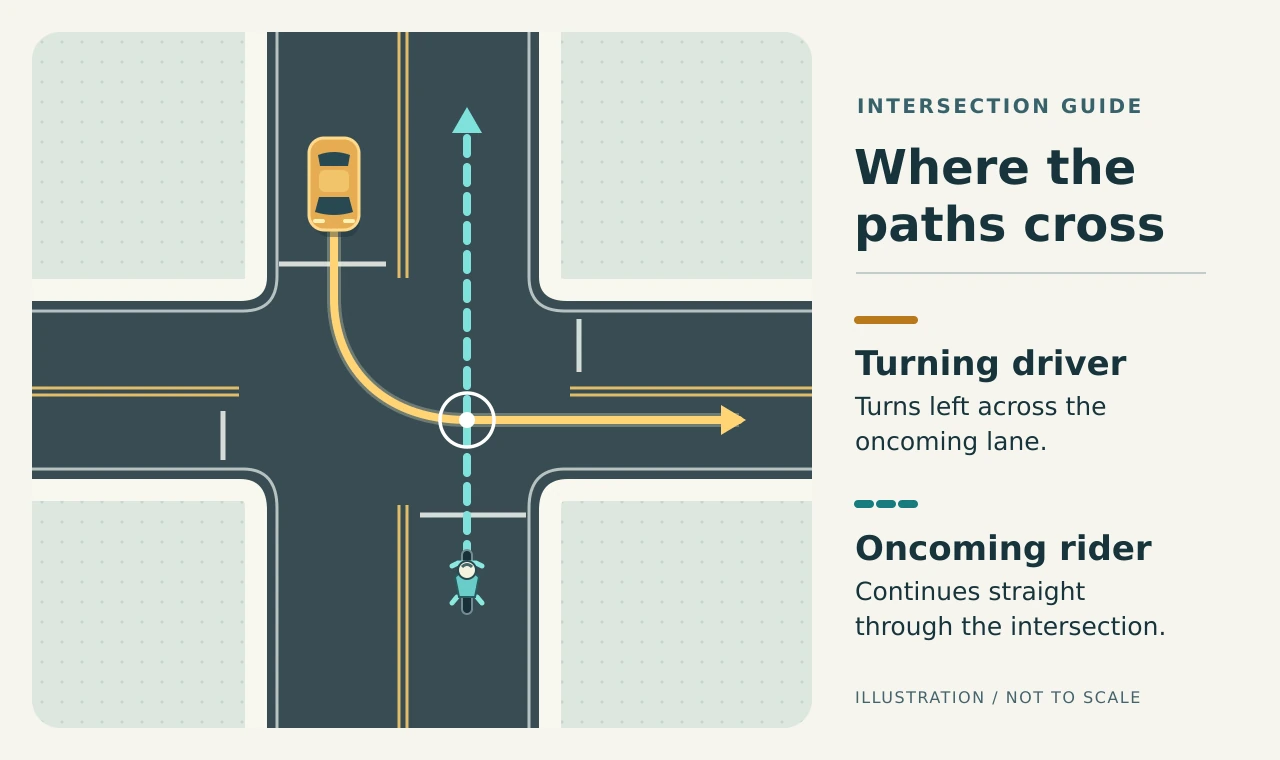
A left turn creates a crossing conflict: the turning vehicle must move through a lane that approaching traffic is using. A driver who misjudges a motorcycle’s distance or speed may begin the turn with too little space to clear that lane. Distraction, a rushed gap decision, or a blocked view can contribute.
Motorcycles have a smaller visual profile than larger vehicles. NHTSA’s motorcycle safety guidance emphasizes the visibility challenges riders face and the importance of drivers sharing the road. Riders also have less physical protection than occupants of enclosed vehicles, so a collision can cause serious injury even when the motorcycle was traveling lawfully.
Driver Failure to Yield at Intersections
Left-turning drivers generally must yield to approaching traffic that has the right of way, subject to the applicable traffic controls and state law. A green light, protected turn arrow, stop sign, or driveway entrance can change the analysis. A driver’s statement that the road looked clear must be checked against the actual sightline and timing.
A turning driver may be responsible for entering an approaching rider’s path without a safe gap. However, the direction of the turn alone does not establish liability. Investigators also examine whether either person disregarded a signal, exceeded a safe speed, or made another movement that contributed to the crash.
Motorcycle Visibility and Blind Spot Issues
Visibility disputes require a close look at the scene. A windshield pillar, another vehicle, parked equipment, vegetation, glare, darkness, or weather may obstruct a driver’s view. A driver may also look toward traffic without recognizing a motorcycle soon enough to respond.
An investigation should distinguish between an obstruction that actually blocked the view and an object that was visible but overlooked. Photos taken from an unrelated angle or at a different time of day may not show what the driver could see. Measurements, camera footage, lighting conditions, and the positions of both vehicles help test each explanation.
“I didn’t see the motorcycle” does not automatically excuse a failure to yield. It also does not prove the complete case. The issue is whether the driver acted with the care the circumstances and applicable law required, and whether that conduct caused the injuries.
Accident Reconstruction in Motorcycle Crashes
Reconstruction connects the physical evidence to the sequence of events. Depending on the case, an investigator may review vehicle damage, debris, tire marks, road measurements, camera recordings, witness accounts, and traffic-signal information. These sources can help estimate the point of impact, travel paths, sight distance, and available reaction time.
Some vehicles have event data recorders that may preserve crash-related information, such as speed or braking. Availability and recorded fields vary by vehicle and event. Electronic data should be obtained and interpreted by qualified professionals; it should not be assumed that every vehicle recorded every disputed movement.
Preserve original camera files and identify nearby businesses or homes that may have footage. Retention periods vary, and recordings can be overwritten. The motorcycle, helmet, riding gear, and other involved vehicles should be documented before repair or disposal when possible. An attorney can assess appropriate preservation requests.
Determining Fault in a Left-Turn Motorcycle Accident
Fault depends on evidence of duty, a breach of that duty, causation, and resulting harm under the governing law. A police report or traffic citation can be useful, but neither replaces a complete review of the collision. Insurer allegations about speeding or poor visibility should be tested against reliable evidence.
Shared-fault rules differ by state. In some jurisdictions, a rider’s share of fault reduces compensation; in others, reaching a specified threshold can prevent recovery. Do not apply a Wyoming, Utah, Washington, or other state’s percentage rule to a crash without first determining which law governs.
The same care applies to deadlines. Injury lawsuits, wrongful death cases, claims involving public entities, and insurance obligations may have different time limits. A deadline from another state or another type of claim is not a safe guide.
For location-specific information, see our Washington motorcycle accident lawyer and Wyoming motorcycle accident lawyer pages. Those pages address their respective jurisdictions rather than creating one rule for all riders.
What Riders Can Do Before and After a Crash
Before a crash, follow traffic controls, leave room to respond, and approach intersections with care. Proper lighting and visible riding gear can help other road users notice you. These precautions cannot guarantee that another driver will yield and do not determine legal responsibility after a collision.
After a collision, prioritize safety and medical care. Call 911 when emergency help is needed, report the crash as required, and obtain the report number. If it is safe, photograph the vehicles, road layout, signals, obstructions, and damage, and collect witness contact details.
Save medical records, bills, missed-work information, original recordings, and damaged gear. Before accepting a settlement or giving a recorded statement to the other driver’s insurer, consider legal advice. Separately, comply with applicable reporting requirements and review any notice or cooperation duties under your own insurance policy.
Questions About Left-Turn Motorcycle Claims
Is the left-turning driver always at fault?
No. An unsafe failure to yield can support liability, but signals, speed, lane movements, and other evidence may affect the result. Responsibility must be assessed under the law governing the crash.
Can visibility evidence help if the driver blames me?
Yes. Scene measurements, original footage, photographs, and reconstruction may show whether the driver had a reasonable opportunity to see the motorcycle. The evidence may support or contradict either person’s account.
Can I seek compensation if I share some fault?
Possibly. The answer depends on the applicable state’s rules and the evidence. A percentage that permits recovery in one jurisdiction may prevent it in another.
Talk With Strong Law About Your Motorcycle Crash
Strong Law Accident & Injury Attorneys can review the circumstances of your crash, identify relevant evidence, and explain the next steps for your situation. Contact Strong Law for a free case evaluation.
This article provides general information, not legal advice. Reading it does not create an attorney-client relationship. The law and facts of an individual case determine the available options.

See If Your Injury Claim May Qualify
Answer a few quick questions to help Strong Law understand what happened and whether your claim may qualify for a free review.
