

Hit by a Turning Driver While Biking in Eugene?

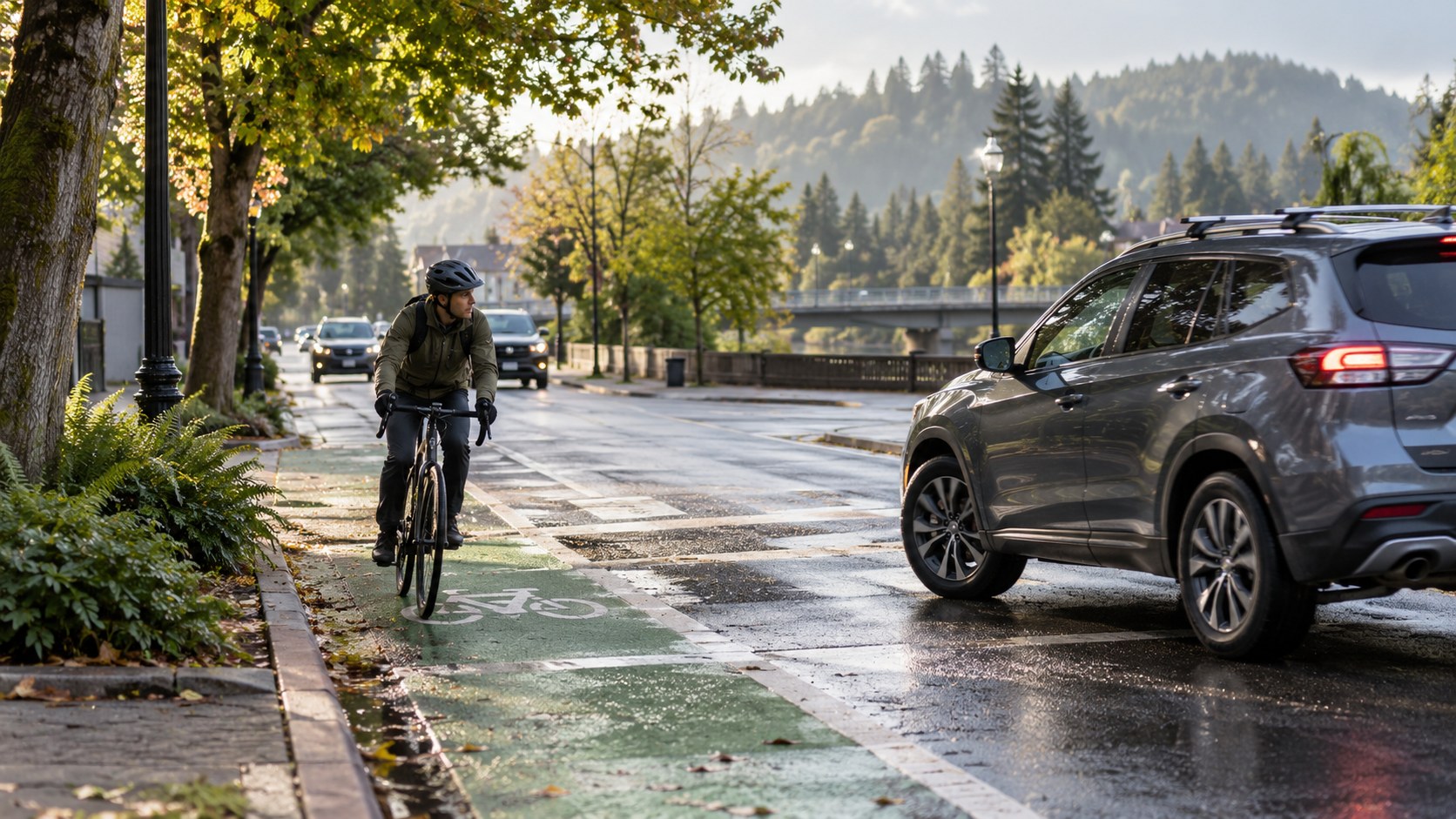
A driver who turns across your path while you are biking in Eugene may be responsible for your injuries. The claim depends on the traffic controls, each person’s movements, and the evidence showing how the collision happened. Being in a bike lane can be important, but the full scene still needs review.
Get medical help, report the crash, and preserve the bicycle and other evidence. Our Eugene bicycle accident attorneys can investigate a turning collision and help you respond if the driver’s insurer disputes responsibility.
These crashes can involve a right turn across a bike lane, a left turn across an approaching rider, or a vehicle entering a driveway. The most useful evidence often explains the few seconds before impact, including where the bicycle was traveling and when the driver began turning.
When must a driver yield to a bicyclist?
Oregon law requires a motor vehicle operator to yield to a person riding in a bicycle lane, subject to the statute’s terms. The state also prohibits a dangerous left turn across an approaching vehicle. Those rules may be relevant when a driver turns across a rider’s path. See ORS 811.050 and ORS 811.350.
The investigation should identify the lane layout and the signals controlling each movement. A green light for one direction does not answer every question about a conflicting turn. A separate bicycle signal, turn arrow, stop sign, or driveway entrance can change the analysis.
Do not assume the driver is automatically responsible for every turning collision, or that a rider automatically loses a claim because the crash occurred outside a marked bike lane. The applicable rules and actual movements need to be considered together.
What is a right-hook bicycle collision?
A right-hook collision describes a driver turning right across the path of a rider traveling alongside or approaching on the right. It can occur after a vehicle overtakes a bicycle or when a rider approaches a vehicle waiting near a turn.
The sequence matters. Investigators may ask whether the driver passed the rider, whether either person changed lanes, when a turn signal appeared, and whether the bicycle continued straight or also turned.
Record those details as soon as you can. If you remember a vehicle passing shortly before impact, note where it passed and how much time elapsed. If you saw a signal, describe when you first noticed it. Avoid filling gaps in your memory with assumptions.
For a crash near downtown Eugene or the University of Oregon, identify the precise intersection and direction of travel. “Near campus” is less useful than a description of the approach, the side of the street, and the driveway or intersection where the turn began.
What should I photograph at the scene?
Take photographs only when it is safe. Your health and immediate safety come first. If you cannot document the scene, ask a companion to preserve what they can without entering traffic.
Useful photographs include:
- The bicycle and vehicle before they are moved, if safe.
- Wide views of the approach and turning path.
- Bike-lane markings, signs, signals, and pavement arrows.
- Damage, debris, and visible marks on the roadway.
- Any obstruction that affected visibility.
Take both wide views and close-ups. A close photograph may show damage clearly but omit the lane layout. A wide photograph may explain the scene while making the point of impact difficult to see.
If someone returns later, label those photographs with the actual date. Construction, parked vehicles, weather, and lighting may differ from the crash conditions. Later photographs can help explain the location, but they should not be presented as images taken during the collision.
Why should I preserve my bicycle and riding equipment?
The bicycle may help show where contact occurred and the direction of impact. Save it in its post-crash condition until you have discussed inspection and documentation with your attorney. Do not sell it, discard damaged parts, or approve repairs without considering whether evidence will be lost.
Preserve the helmet, damaged clothing, lights, camera, and other relevant equipment as well. Do not keep using damaged safety equipment simply to preserve it. Store it and obtain appropriate replacement equipment before returning to riding.
Ask a repair shop for a written assessment and photographs before work begins. Keep receipts and information identifying the bicycle and accessories. A shop’s repair estimate can document property loss, while a qualified inspection may answer different questions about how the crash happened.
Avoid cleaning or altering items in a way that removes marks or other relevant information. Tell your attorney where the equipment is stored and whether anyone has already inspected it.
How can video and witnesses help establish the turning sequence?
Video may show the rider’s position before impact, a vehicle’s turn, or the signal sequence. Preserve original camera files, including a reasonable period before and after the collision. Do not rely only on a cropped clip or a social media upload.
Note nearby businesses, residences, buses, or vehicles that may have cameras. Ask promptly whether footage exists and can be preserved. A camera visible on a pole may monitor traffic without retaining recordings, so do not assume a recording will be available.
Witnesses can provide details you could not see from the bicycle. Get names and contact information, and note where each person was standing or traveling. Ask them to describe what they observed in their own words.
Avoid coordinating accounts. Differences in viewpoint can be useful when they are documented honestly. An attorney can follow up and assess how each account fits the physical evidence.
What if the driver says I came out of nowhere?
That statement does not resolve fault. The investigation should examine sight lines, lighting, obstructions, lane position, vehicle speed, and the driver’s opportunity to observe the rider.
Keep evidence of the bicycle’s lights and reflective equipment when relevant. If a light was damaged in the collision, preserve the unit and any available photographs from before the crash. Also document weather and visibility without exaggerating what you can establish.
If the insurer says you were moving too quickly, ask what evidence supports that claim. Video, witness accounts, route data, and physical evidence may help, but none should be treated as conclusive without review.
Provide accurate information about your own movement. If you changed position to avoid debris or an obstruction, explain the location and reason. A clear account of what happened is more useful than trying to make the ride sound perfect.
Can I recover if the insurer says I share fault?
An allegation of shared fault does not automatically defeat an Oregon injury claim. Under ORS 31.600, a claimant may recover when their fault is not greater than the combined fault of the people included in the legal comparison. Compensation is reduced by the claimant’s percentage of fault.
For a simple hypothetical involving one driver, if a rider is assigned 20% fault and the supported damages are $100,000, the reduction would leave $80,000 before other applicable adjustments. This illustrates the calculation, not the expected value of a bicycle case.
An insurer’s proposed percentage is not automatically the final legal determination. Ask how it reached that number and which evidence supports it. Our guide to shared fault in Oregon injury cases explains the broader issue.
What medical and work records should I keep?
Keep discharge instructions, visit summaries, treatment recommendations, prescriptions, and bills. Tell medical providers how the collision occurred and describe symptoms accurately. If a symptom changes or a new problem develops, contact an appropriate provider rather than relying on an insurance adjuster’s assessment.
Save written restrictions on lifting, standing, driving, or other work activities. If you miss shifts, ask your employer for records showing the time missed and pay affected. Self-employed riders may need invoices, schedules, and other business records to explain the loss.
Document practical effects without turning the record into a script. For example, note when an injury prevented you from performing a normal task and what assistance you needed. Include improvement as well as limitations.
If cost or transportation prevents follow-up care, tell the provider and your attorney. Keep a record of the barrier and any efforts to arrange another appointment. That helps explain a gap in treatment.
What insurance might apply to a bicycle injury?
The driver’s liability insurance is one potential source when the driver is legally responsible. Depending on the circumstances and policy language, other auto or health coverage may also need review. Do not assume your own auto policy is irrelevant simply because you were riding a bicycle.
Ask an attorney to review the available policies and the crash facts before concluding which insurer should pay. Report the collision accurately and preserve any written coverage decision.
Keep the bicycle repair discussion separate from the injury settlement. An agreement resolving equipment damage should be examined for language that might also release bodily injury claims.
If the driver was using a work vehicle or making a delivery, record that information. It may affect the coverage investigation, although employment or vehicle branding alone does not establish liability.
What if a roadway hazard contributed to the turn or fall?
Photograph the condition, its location, and how it affected your route. Glass, debris, a blocked lane, or damaged pavement may help explain why you changed position. That does not automatically establish a separate claim against a property owner or public agency.
Eugene’s iBikeEugene reporting tool allows riders to report bike-lane hazards with location information and a photograph. A maintenance report serves a different purpose from a police crash report, an insurance claim, or a required legal notice.
If you believe a public roadway condition contributed to your injury, raise it with an attorney promptly. Special notice requirements can apply. Do not assume that sending a hazard report protects the right to bring a claim.
What questions come up after a turning collision?
Does the driver need to receive a ticket for me to have a claim?
No. A citation and a civil injury claim involve different decisions. The absence of a ticket does not replace an investigation of the evidence and applicable duties.
Can I get help if I do not remember the impact?
Yes. Tell your attorney what you remember and where the gaps begin. Witness accounts, physical evidence, medical records, and video may help reconstruct events. Do not guess to fill missing details.
Should I post the video online to find witnesses?
Preserve the original file first and discuss public posting with your attorney. A short public clip can omit important context. A targeted request for witnesses may be possible without publishing the complete evidence file.
Is the insurance company’s first offer my only option?
No. You can ask how the insurer calculated the offer and review whether it accounts for the supported losses. Do not sign a final release before understanding continuing treatment needs and the claims it would resolve.
How can Strong Law help after a Eugene bicycle collision?
Strong Law Accident & Injury Attorneys can review the turning sequence, available evidence, and insurance issues. We can also help assess an allegation of shared fault and the records needed to support an injury claim.
Request a free consultation about your Eugene bicycle crash. Bring photographs, insurer correspondence, and the location of the bicycle or other evidence you have preserved.

See If Your Injury Claim May Qualify
Answer a few quick questions to help Strong Law understand what happened and whether your claim may qualify for a free review.
